Articles
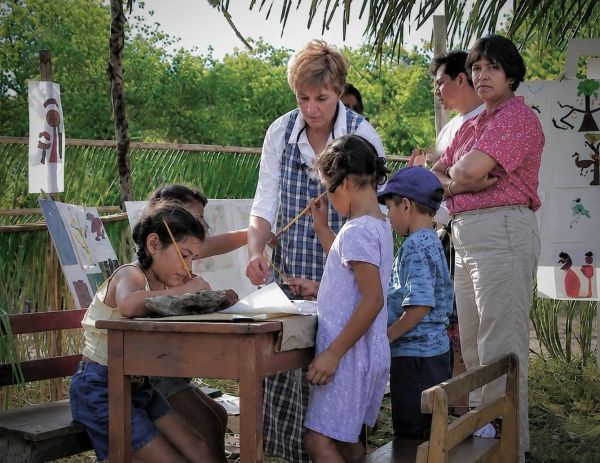
"The Children Who Want to Fly"
~ Every child has the right not only to belong to their own generation, but to be prepared to participate fully in it. ~
The horse and buggy is moving forward, the adult driver facing the road ahead, while the children ride in the open storage space at the back, looking toward us. One girl smiles. The other looks uncertain.
Perhaps they were simply waving to someone they knew. But when I first saw the photograph, I was struck by the strange reversal of direction: the adults were moving forward while the children were looking back.
It made me wonder what it means for a child to move into a future that has been largely defined by the generation before them. What do we give children to carry forward—and what do we leave them free to discover for themselves?
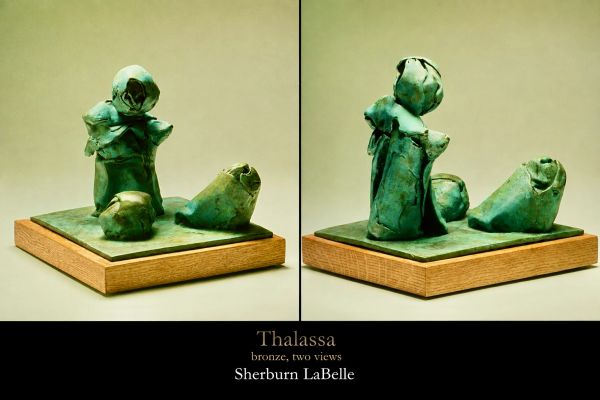
The Horizon Hesitates: Thalassa
“Once having traversed the threshold, the hero moves in a dream landscape of curiously fluid, ambiguous forms, where he must survive a succession of trials.”
— Joseph Campbell, The Hero with a Thousand Faces
Thalassa is the name I gave to the bronze before you, above.
She is the mother of the sea — the serene and the tempestuous
the enveloping and the sensual, the fertile and pleasurable,
the sea that can hold you and the sea that can drown you. The moon is her gravity.
Perhaps this is what I wanted most from Thalassa:
Not to make her safe, but to make her whole...

The Shape of What Is Not There ~ The Doorways Within ~ part one
Introduction: Beneath Our Skin
To encounter sculpture is to step into a physical conversation where the lines between you and the object completely blur. Much of the traditional language around sculpture has been about conquering stone or forcing a passive material into shape. But as an artist working with these forms, I see the studio as a place of alchemy. It is the quiet magic of making heavy, stubborn materials hold a human breath.
This paper is about the physical awakening that happens directly beneath our skin. When you move past looking at art as a flat image, it becomes a living dialogue between your body and the material in front of you. Your eye and your flesh work together to fill in the blanks, naturally supplying everything the artwork deliberately leaves out.
It is an experience that resonates deep inside us, spiraling inward through three pieces:
- We see a body where there isn’t quite a body.
- We hear sound in a sculpture that makes no sound.
- We feel the shape of an animal where parts of the animal are missing.
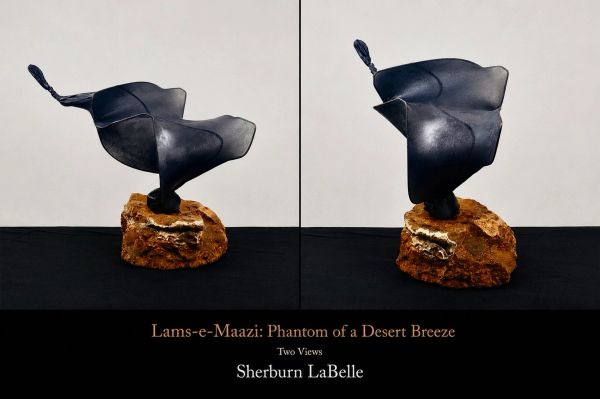
Where Matter Finds Its Way~The Outward Thresholds~ part two
Introduction: Materializing the Unseen
We begin with three thresholds: the desert wind, the river, and the ocean wave.
Each opens onto a different encounter with the world. The wind draws us outward into the landscape. The river carries us through time, memory, and uncertainty. The wave pulls us toward the ocean and the horizon, toward what we cannot yet know.
These are not answers we have settled on. They are doorways where matter finds its way. Thresholds of thresholds.
Wind that cannot be held.
Water that cannot be stopped.
The sea that has no single body.
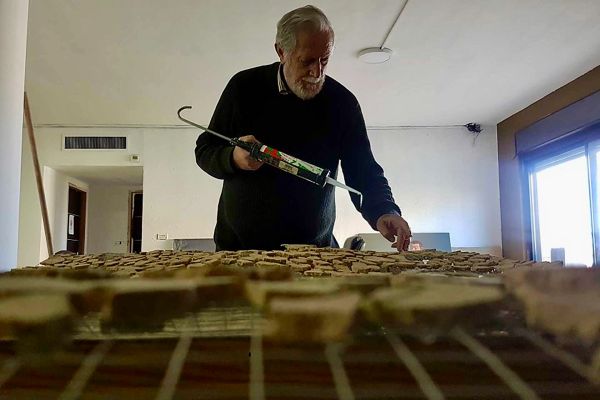
Sliman Mansour
~ The Shape of Heritage: Soil, Mud, and Resistance~
The recent passing of the great Palestinian artist Sliman Mansour, on August 24, 2026, has made me think again about the first time I encountered his work. I was struck not only by what he was saying through his images, but by how he worked with material.
Mansour began mixing mud, clay, straw, and henna on wood. For him, mud carried two meanings at once. It was connected to childhood memories of watching his Salman grandmother build mud ovens in Birzeit, but it was also literally the soil of Palestine transformed into material for his art.

"Penelope Shroud" ~When Title Becomes Material~
Without its title, we encounter a dancer. With it, we begin to recognize Penelope. The title is not attached to the sculpture. It is one of its materials.
The Treaty of Gravity: ~Negotiating With the Talking Heads~
Present-day society is trapped in an apprehensive, hyper-fast capitalist loop that treats everything—including art—as a predictable, standardized commodity.
When Form Speaks In Riddles: Art As Phenomena
~A sculptor’s reflection on perception, time, and the unseen~
Have you ever stood in front of an ancient carving or a grave marker where you had no idea what it was about—and fell completely silent?
Observing Place ~Art, Culture, and Ways of Looking~
Understanding culture often begins not with explanation, but with attention. Before language, before theory, there is place....
A Quiet Marker ~Every Garden Needs A Sculpture~
I am particularly fond of pollinator gardens. They are places of extraordinary beauty—alive with movement, sound, and quiet intelligence—and they offer a natural setting in which art can exist as part of a living system rather than apart from it....
Creative Descent ~experiences that carried time~
The training an artist receives shapes not only what they make, but how they understand their place in the world. Technical skill matters — but technique alone cannot carry meaning. Meaning is shaped by context, by history, by material, and by the lived realities that artists move through over time.

Thank you for reading!
All Photographs and written material are Copyright © 2026 Yampa Path / Sherburn LaBelle - All Rights Reserved. Please ask me for permission to use them.
Self-published Books / Sherburn LaBelle

"Ajahn Jamnian" Thai Buddhist Meditation Master
"Owl Always Be Waiting" by Brenda Sherburn (LaBelle)
"Ajahn Jamnian" Thai Buddhist Meditation Master
2015 Retreat in Olympia
Washington, USA
For Retreat Participants only.
Edited & Designed
by Brenda Sherburn LaBelle
All photos taken
by Brenda Sherburn LaBelle
Printed Book, 40 pages
©️Published Apr 11, 2016
"Selected Poetry" by Tahir Khan Arzani
"Owl Always Be Waiting" by Brenda Sherburn (LaBelle)
"Ajahn Jamnian" Thai Buddhist Meditation Master
A Pakistani artist & poet in Lahore. Tahir writes in English, Urdu, Persian & Punjabi. He illustrates each poem with his beautiful photo-paintings.
Compiled & Designed with Introduction by Brenda Sherburn (LaBelle)
Pages: 82
©️Published Apr 12, 2014
"Owl Always Be Waiting" by Brenda Sherburn (LaBelle)
"Owl Always Be Waiting" by Brenda Sherburn (LaBelle)
"Owl Always Be Waiting" by Brenda Sherburn (LaBelle)
A collection of poetry,
including photographs of
Sherburn LaBelle's
Sculpture & Drawings.
Printed Book 36 pages
©️Published Aug 28 2013
Will be re-printed with a new cover next year.