(draft) ~ Studio Archive ~ Inventory and Provenance
Inventory and Provenance
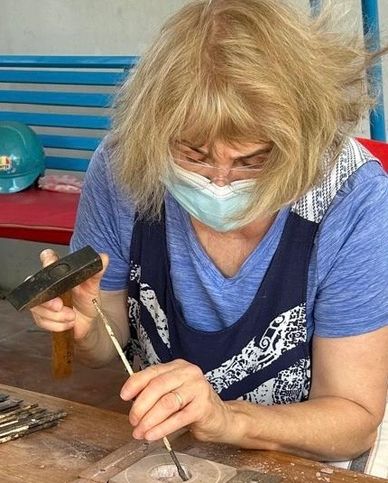
This ABOUT ME page moves away from the traditional artist CV and instead traces a working chronology through studios, environments, and lived periods. The studio spaces become the structure through which sculpture, ideas, friends, family, and artistic practice evolve, each carrying its own story. Long before formal training, the need for a room of one’s own had already begun. When I had children, I was determined not to become one of those women artists who stopped making art. Curiously, it was my children who gave me the day-to-day structure I needed to continue working. They kept me grounded.
This archive is deliberately not about career advancement. It is about continuity of making across changing conditions.
And So It Began 1972-76 Apprenticeship, NESA Foundation Program Cambridge/Boston, Massachusetts

I dropped out of High School at sixteen, moved to the coast of Maine, got a job waiting-tables. I wanted to be a sculptor. So started carving reliefs in plaster in my room at the boarding-house.
At the end of that summer I moved to Boston/Cambridge area.
Late one night while I was wandering the streets of Harvard Square in Cambridge, I saw a light burning in a basement window. I peered through the window. There was Robin Binning working on a huge sculpture. I started banging on the window until he came up the stairs to the door. I told him I wanted to be a sculptor.
I asked him if I could work as his apprentice. He said NO, banged the door shut in my face. I banged on the window again, harder this time. He opened the door again and said, "If you want to work with me enrolled at The New England School of Art in Boston. And before I had a chance to say anything, he banged the door shut again... So it began.
~~Room of My Own ~~ 1982–1987 Conklin Ave Binghamton, New York ·
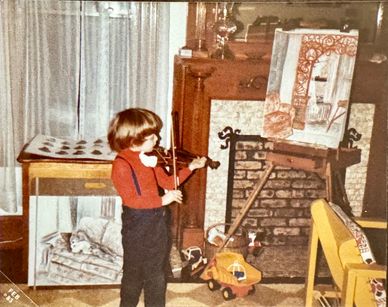
During the SUNY Binghamton years, sculpture, drawing, music, and family life occupied the same small rooms. Because my son practiced violin in the middle of the studio, I would drew him.
Link to stories coming soon...
1988 Precision Sharpening My Dad's Shop. Plymouth, New Hampshire ·
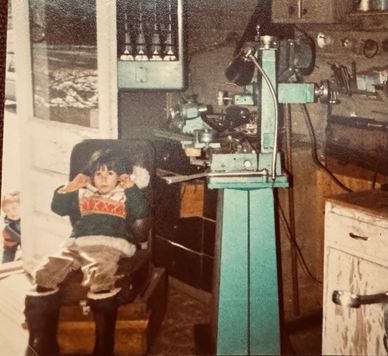
The sharpening shop became another temporary workspace. My daughter covered her ears when the grinder started while my son waited by the door.
Late 1980s. The Barn Studio Rumney, New Hampshire
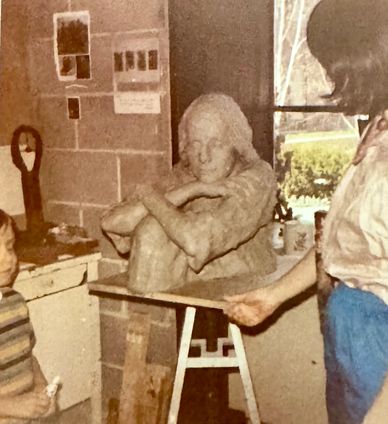
Winter work continued in a partially heated barn studio where larger figurative sculptures first began to emerge.
1990 Ford Street Studio Alameda, California
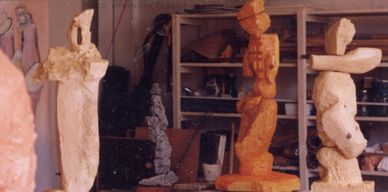
The Alameda years moved between a industrial space, teaching, and abstract assembled figurative work and pastel drawings on old window-shades. Finished works often migrated back home when the studio became too crowded.
1995-98 Boat Yard Studios Alameda Marina, California
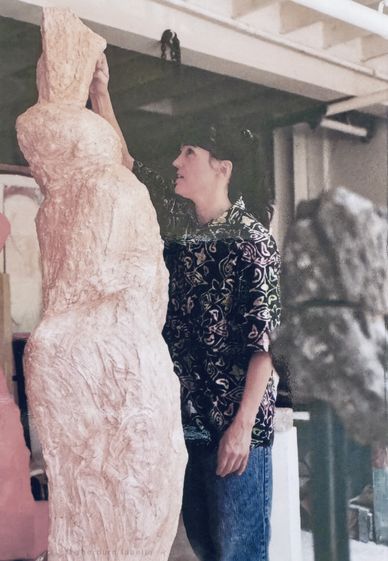
Finding the marina space in Alameda at the Boat-Yard gave me the ability to work larger than life.
Fort Bidwell's High Desert Studios
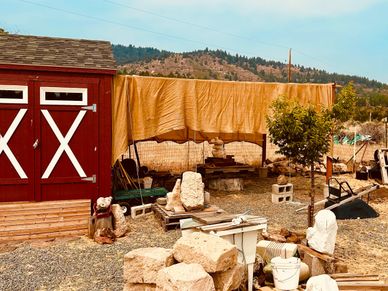
2010–2019~Water St Studio
2019-present~Yampa Path.
Fort Bidwell's high desert location develops a conversation with material, open space, seasonal light for a new kind of sculptural energy.
Fairfax Studio 1999-2026
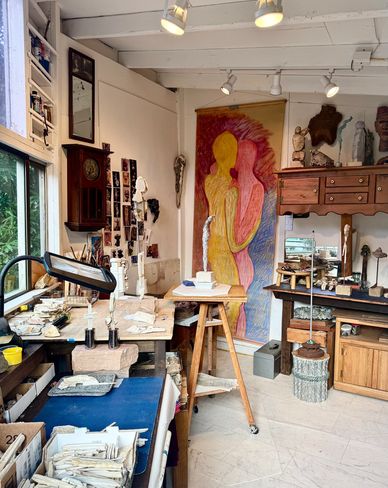
The Fairfax studio became a long-term working environment where sculpture, drawing, found materials, and open studio conversations accumulated over decades.
